


Our Blog: "News about handmade pottery, the potters, Clay Pot Users and Clay Pot Cooking"

March is Tagine Month!


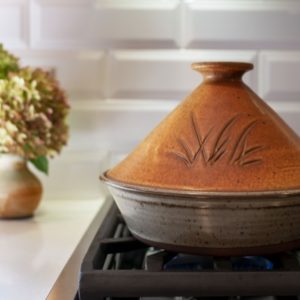
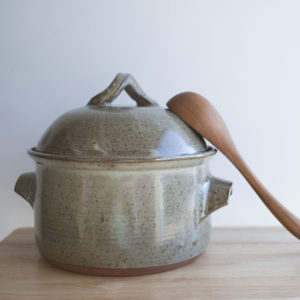
Sage Green Tagine

Sage Green Tagine


TAGINE, the name of both the dish and the pot it is cooked in, are traditionally done on the stovetop so the moisture condenses on the cool stoneware top and drops back into the flameware dish.  The lid on the tagine is designed  to encourage this condensation. The necessary moisture loss (to thicken the broth) occurs in the fit between the lid and base. The big advantage of the Clay Coyote flameware based tagine, over earthenware, is that you can do any high temperature pre-cooking like sauteeing  onions, garlic, browning meat, then lower the heat to cook the traditionally simmered tagine.
This piece can bake, broil, stew, simmer, saute, and serve.

We will be posting our favorite tagine recipes this month, as well as experimenting with new uses for the dish. I just recieved a tagine for my birthday. If you have been considering adding a tagine to your collection, March is the time to do it. We have a variety to chose from in our gallery. We also have a nice selection in our studio waiting to be glazed.

This is from Paula Wolfert’s Mediterranean Clay Pot Cooking book. Betsy and Tom made this for our summer dinner party. It was amazing!


Moroccan Tagine next to couscous

Moroccan Tagine and steamed couscous

Moroccan Lamb Tagine with

Winter Squash and Toasted Pine Nuts


2 pounds thick bone in lamb shoulder arm chops

2 1/2 to 3 pounds butternut squash

Coarse salt

1/8 teaspoon saffron threads

1 large onion, grated, plus 2 medium onions, sliced

Salt and freshly ground pepper

2 teaspoons La Kama

2 teaspoons smen (optional)

Pinch ground cinnamon

Pinch ground ginger

1 Tablespoon lavender or orange flower honey

3 tablespoons unsalted butter

2 tablespoons pine nuts, toasted

1.  Trim any excess fat from the lamb. Cut the chops into 1 1/2 inch chunks with the bones.

2.  Peel the squash and scrape out the seeds and membrane. Shred the squash. Sprinkle liberally with coarse salt and drain in a colander for about 1 hour. At the same time, soak the saffron in 1/3 cup warm water.

Step 3

Step 3

3. Place the lamb, grated onion, saffron, and its water, 1 teaspoon salt, 1 1/2 teaspoons of La Kama, and the smen in the tagine. Stir to mix well. Cover and cook on low heat for 1 1/2 hours.

4. Stir the sliced onions and continue to cook, covered, for 1 hour longer. Pick out the pieces of lamb and let stand until cool enough to handle. Cut out and discard the bones. Skim off the cooking liquid in the tagine. Season the meat with salt and pepper and return to the tagine.


5.  Rinse the grated squash under cold running water and squeeze in your hands over a bowl to catch the juices. Measure out and reserve 2 tablespoons of the juice; discard the remainder. Place the grated squash in a 10 inch nonstick skillet. Add the cinnamon, ginger, honey, remaining La Kama, 2 tablespoons of the butter, and the reserved 2 tablespoons of squash liquid. Slowly fry until the squash is thickened to a jam like consistency and colored a golden carmel, about 15 minutes.

6. Preheat oven to 300F. Ladel 1/2 the sauce from the tagine over the squash and stir to combine. Spread the squash and stir to combine. Spread the squash evenly over the lamb. Dot with the remaining 1 tablespoon butter and place tagine in the top third of the oven. Raise heat to 425F and bake, uncovered, until the squash is lightly glazed, about 30 minutes. Remove from oven, be sure to set the tagine down on a wooded surface. Serve the tagine hot or warm, with the pine nuts scattered on top.

Do you have a delicious tagine recipe to share? We will be selecting one recipe to feature here on our blog. Send in your ideas, and you could be the March feature.

Coming soon…  Israeli  Couscous and lentil stuffed peppers

Turkish Red Lentil, Bulgur, and Mint Soup… Ezo Gelin Corbasi

This is a recipe for a lentil soup I found in Clifford A. Wright’s cookbook, The Best Soups in the World. This is a popular Turkish soup, often made during the cold Mediterranean winter months. I thought with the recent snowfall, now would be a perfect time to try this recipe.  He explains how this soup is known as the bride’s soup, ezo gelin corbasi,  because it is made for the soon-to-be-married young maiden.

“Originally from southeast Anatolia, the origin of this soup is attributed to an exceptionally beautiful woman named Ezo, who lived in the village of Dokuzyol near Gaziantep in the early 20th c. Legend has it that Ezo, with her rosy cheeks and black hair, was admired by travelers along the caravan route who stopped to rest in her village. Many men longed for her hand in marriage and Ezo’s family hoped to secure a worthy match for their daughter. Unfortunately, Ezo the bride (gelin), didn’t have much luck when it came to finding marital bliss. Her first husband was in love with another woman and she divorced him on grounds of maltreatment. Her second marriage took her to Syria where she became homesick for her village and had to deal with a difficult mother-in-law who couldn’t be pleased. It is for her, the story goes, that Ezo created this soup. After bearing 9 children, poor Ezo died of tuberculosis in the 1950s and has since become a Turkish legend, depicted in popular films and lamented in folksongs. Her name lives on in this popular soup, which is now traditionally fed to brides to sustain them for the uncertain future that lies ahead.” 04/2006 Dilek Barlow

I found all of the ingredients for this recipe locally. I picked up the red lentils at Dan and Becky’s Market in Cokato. If you haven’t been there, I would recommend you make the short trip. They carry a wide variety of “pantry” foods and fresh produce at their 10 acre farm. I had trouble finding dried mint locally, so I substituted fresh mint.

Red Lentils from Dan and Becky's market in Cokato

Red Lentils from Dan and Becky's market in Cokato

Lentil and Mint Soup

1 cup red lentils (rinsed)

2 quarts vegetable broth (substitute veal or chicken)

1 medium-large onion, grated

1/2 cup medium or coarse bulgur (#3 or#4), rinsed

1/4 cup unsalted butter

1 T tomato paste diluted in 1/4 cup water

Salt to taste

1 t hot or sweet paprika

1 T dried mint

Cazuela boiling soup...

Cazuela boiling soup...

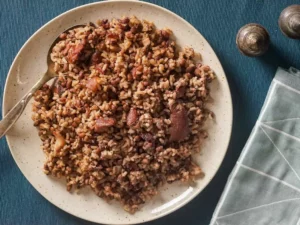
In our Clay Coyote Cazuela, add the lentils, broth, onion, bulgur, butter, tomato paste, and salt. Bring to a very gentle boil over high heat, about 5 minutes, then reduce heat to very low and cook until the lentils and bulgur are tender and the soup has a creamy consistency, about 1 hour. Stir in paprika and mint, cook 5 more minutes, and serve in a Clay Coyote stoneware soup bowl. I garnished my soup with fresh mint leaves.

Red Lentil and Bulgur Soup with Mint

Red Lentil and Bulgur Soup with Mint

Mediterranean Clay Pot Cooking-Paula Wolfert

Clay_Pot-Cooking_w_skillet

Well, we have to admit it, we’re kind of proud….of Paula Wolfert for her most beautiful book yet, with recipes that’ll make you drool; and to be a part of that new book: Mediterranean Clay Pot Cooking.

We just got our initial supply in and will have them up on the website in an hour or so.

Clay_Pot_Cooking_F&B

And we’ll have a price that’ll be more than competitive in that, with the $30.00 purchase of the book, we’ll include a certificate good for $10.00 off the purchase of any Clay Coyote pot.

Even without the ‘deal’ we think you’re going to find this one of those cookbooks you keep right up front. Just reading some of the recipes makes my mouth water.

Clay_Pot_Cooking_FrontispcBut it’s also going to become the ‘go-to’ reference on cooking with clay pots, both modern and indigenous.

Clay has been used essentially ever since man started cooking food, first for storage, then for actual cooking.

And as Paula discusses, there is something about pottery and food that just go together. There aren’t many metal pans you’d put on the table to serve with, but pottery just seems to go there naturally.

Clay_Pot_Cooking_InsideAbove is the frontispiece with a new flameware casserole which you can use like a crockpot. Betsy also made perfect risotto the first time out with one of them.

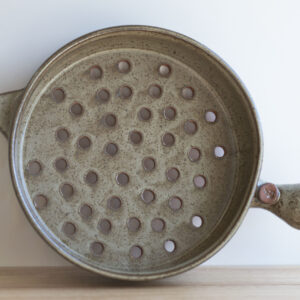
On the right is the Introduction with a couple more Clay Coyote Flameware pieces…saucepan and skillet.

So order your copy now. We can ship immediately.

Our Special Price ($30) includes a $10 certificate for Clay Coyote pottery.

Paula Wolfert and Flameware Pottery

As followers of Clay Coyote know, we’ve been working on developing a Flameware Stovetop Ceramic Cookware line for clay pot cooking some time now.
We just got our copy of ‘Food and Wine’ magazine today, in which Paula

Wolfert has a great article on Cooking in Clay. Her new book Mediterranean Clay Pot Cooking will be out in a month. As she was writing it, we had some long conversations on why food tastes better when cooked in clay pots. If you’ve tried our new Flameware Stovetop Ceramic Cookware, you’ll probably agree-food really does taste better when cooked in clay pottery.
My theory is that metal pots transmit heat very quickly. Clay, on the other

hand, is an insulator. When you put heat to a clay pot, it comes through very slowly. I think the metal causes a very slight burning where the food meets the pan. If you control your heat in a clay pot, this doesn’t happen and the food doesn’t get the bitter, burned taste that metal gives. Paula thinks it’s because the indigenous low fired clay pots that will withstand direct heat

gather flavors over time. In low fired ware, there probably is some flavor transfer. Our new Flameware is high-fired and I don’t think the pot itself picks up any flavor…so we’re probably both right.

So far we’ve cooked an apple pancake that starts in the skillet and ends in the oven, oatmeal almost daily, scrambled eggs and ham almost daily, risotto (fabulous) in the casserole, tagines in the tagine, Pollo Verde in the cazuela, stir-fried vegetables in the skillet and many more.

We’ll be getting some recipes on the website and would like to hear your thoughts and shared recipes.