

Our Blog: "News about handmade pottery, the potters, Clay Pot Users and Clay Pot Cooking"

Roasted Garlic Zucchini Dip

Freshly picked garlic from Loon Organics

8 More days until the Garlic Festival here in Hutch. It is all things garlic this month here at Clay Coyote. We will be featuring our tastiest garlic recipes prepared with our favorite Clay Coyote pieces. I will be creating my dishes from my weekly produce box from Loon Organics. I was inspired to create this dish after a recent discussion on different methods of preparing baba ghanoush. I thought, “Zucchini might be a tasty alternative to eggplant.” Mmm mmmmmm I was right!  I had previously roasted and then frozen multiple heads of garlic, so this recipe was prepared in less than 10 minutes.
[Read more...]

Fennel, Scallion, and Egg Spread

I have taken a hiatus from my oven during our recent heat wave. After working outside, the last place I want to be is over my hot stove. This makes menu planning for week 5 a new type of challenge. Use my entire box, 2 dozen farm fresh eggs, heat up the house as little as possible, and create a flavor explosion for my mouth. Week 5′s box is packed full of old friends, broccoli, cauliflower, carrots, and cucumber, to name a few. There is also a stranger in the midst. Fennel. I did a little research and discovered Fennel dates all the way back to 500 BC. The Greek word for fennel is marathon. The Battle of Marathon was fought on a field of fennel. This hardy perennial flavors absinthe, wards off fleas, and helps soothe digestive troubles. Prometheus brought fire to man in a fennel stalk. Impressive herb! [Read more...]

Vinegar-Poached Sturgeon with Thyme-Butter Sauce

Vinegar-Poached Sturgeon with Thyme-Butter Sauce

By Paul Wolfert

ACTIVE TIME: 35 MIN

TOTAL TIME: 2 HRS

SERVES: 4

This is a Paula dish we recommend trying with your homemade vinegar. Send us your pictures of this dish, and maybe we will feature them here on our blog!

INGREDIENTS

4 medium zucchini (1 1/2 pounds), sliced crosswise 1/2 inch thick

Salt

2 tablespoons unsalted butter, softened

1 teaspoon chopped thyme

Freshly ground pepper

3 tablespoons extra-virgin olive oil

Four 6-ounce skinless farmed sturgeon or wild Pacific halibut fillets

3 tablespoons homemade red wine vinegar

3/4 cup water

Bouquet garni made with 2 parsley sprigs, 1 bay leaf and the leafy top of 1 celery rib, tied with kitchen string

1 medium shallot, thinly sliced

3 tablespoons capers, drained and rinsed


DIRECTIONS

1. Preheat the oven to 375°. On a large rimmed baking sheet, sprinkle the zucchini slices with salt. Arrange them in an even layer and let stand for 1 hour. In a small bowl, blend the butter with the thyme and season with salt and pepper.

2. Rinse the zucchini slices and pat dry; wipe off the baking sheet. Return the zucchini to the baking sheet and toss with 2 tablespoons of the olive oil. Spread the slices in an even layer and bake until golden brown on the bottom, about 30 minutes. Transfer the zucchini to a platter.

3. Sprinkle the sturgeon with 1 tablespoon of the vinegar and refrigerate for 10 minutes. In a large, heavy skillet, combine the remaining 2 tablespoons of vinegar with the water, bouquet garni and shallot and bring to a boil. Season the poaching liquid lightly with salt and pepper and add the sturgeon fillets. Cover tightly and simmer over low heat, turning once, until the fish is barely cooked through, about 8 minutes. Transfer the sturgeon to a large plate. Strain the poaching liquid into a bowl.

4. Wipe out the skillet and set it over high heat. Add the remaining 1 tablespoon of olive oil and heat until shimmering. Add the sturgeon fillets, boned side down, and cook until golden brown on the bottom, about 2 minutes. Turn and cook for 1 minute longer. Set the sturgeon on the zucchini and cover with foil to keep warm.

5. Add the strained poaching liquid to the skillet and boil over high heat until reduced to 1/3 cup, about 5 minutes. Stir in the capers and remove from the heat. Swirl in the thyme butter and season the sauce with salt and pepper. Transfer the sturgeon and zucchini to plates, spoon the sauce on top and serve.

From Food & Wine Magazine October 2006 www.foodandwine.com


Chicken in Red Wine Vinegar


Chicken in Red Wine Vinegar

ACTIVE TIME: 25 MIN

TOTAL TIME: 1 HR 5 MIN

SERVES: 4

For Paula Wolfert, this rustic Lyonnais dish is comfort food. Slow cooking transforms red wine vinegar, tomato, shallots, garlic and a touch of honey into a perfectly balanced sauce for chicken. This is the recipe we recommend to try after crafting your own vinegar using our Vinegar Crock.

INGREDIENTS

14 tablespoons red wine vinegar

1/2 cup low-sodium chicken broth

1 tablespoon honey

1 tablespoon tomato paste

2 tablespoons unsalted butter

8 large chicken thighs, trimmed

Salt and freshly ground pepper

4 garlic cloves, thinly sliced

3 large shallots, thinly sliced

3/4 cup dry white wine

2 tablespoons crème fraîche

3 tablespoons chopped tarragon


DIRECTIONS

1. In a medium saucepan, bring the vinegar, broth, honey and tomato paste to a boil, stirring well. Simmer the vinegar sauce until reduced to 1/2 cup, about 8 minutes.

2. Heat the butter in a large, heavy skillet. Season the chicken thighs with salt and pepper and add half of them to the skillet, skin side down. Cook over moderate heat, turning once, until browned. Transfer to a plate. Repeat with the remaining thighs.

3. Add the garlic and shallots to the skillet and cook over low heat for 5 minutes. Add the wine; boil until reduced to 1/4 cup. Add the vinegar sauce and bring to a simmer.

4. Return the chicken to the skillet, skin side up. Cover and simmer over low heat until cooked through, about 20 minutes. Transfer the chicken to plates.

5. Add the crème fraîche to the skillet and boil for 3 minutes. Add the tarragon and season with salt and pepper. Pour the sauce over the chicken and serve.

WINE PAIRING RECOMMENDATION: Red-cherry rich 2004 Potel-Aviron Juliénas Vieilles Vignes.

Recipe by Paula Wolfert

From The Virtue of Homemade Vinegar

This recipe originally appeared in October, 2006. Food and Wine Magazine www.foodandwine.com


March is Tagine Month!


Sage Green Tagine

Sage Green Tagine


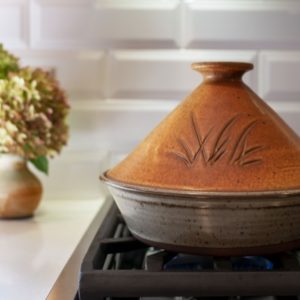
TAGINE, the name of both the dish and the pot it is cooked in, are traditionally done on the stovetop so the moisture condenses on the cool stoneware top and drops back into the flameware dish.  The lid on the tagine is designed  to encourage this condensation. The necessary moisture loss (to thicken the broth) occurs in the fit between the lid and base. The big advantage of the Clay Coyote flameware based tagine, over earthenware, is that you can do any high temperature pre-cooking like sauteeing  onions, garlic, browning meat, then lower the heat to cook the traditionally simmered tagine.
This piece can bake, broil, stew, simmer, saute, and serve.

We will be posting our favorite tagine recipes this month, as well as experimenting with new uses for the dish. I just recieved a tagine for my birthday. If you have been considering adding a tagine to your collection, March is the time to do it. We have a variety to chose from in our gallery. We also have a nice selection in our studio waiting to be glazed.

This is from Paula Wolfert’s Mediterranean Clay Pot Cooking book. Betsy and Tom made this for our summer dinner party. It was amazing!


Moroccan Tagine next to couscous

Moroccan Tagine and steamed couscous

Moroccan Lamb Tagine with

Winter Squash and Toasted Pine Nuts


2 pounds thick bone in lamb shoulder arm chops

2 1/2 to 3 pounds butternut squash

Coarse salt

1/8 teaspoon saffron threads

1 large onion, grated, plus 2 medium onions, sliced

Salt and freshly ground pepper

2 teaspoons La Kama

2 teaspoons smen (optional)

Pinch ground cinnamon

Pinch ground ginger

1 Tablespoon lavender or orange flower honey

3 tablespoons unsalted butter

2 tablespoons pine nuts, toasted

1.  Trim any excess fat from the lamb. Cut the chops into 1 1/2 inch chunks with the bones.

2.  Peel the squash and scrape out the seeds and membrane. Shred the squash. Sprinkle liberally with coarse salt and drain in a colander for about 1 hour. At the same time, soak the saffron in 1/3 cup warm water.

Step 3

Step 3

3. Place the lamb, grated onion, saffron, and its water, 1 teaspoon salt, 1 1/2 teaspoons of La Kama, and the smen in the tagine. Stir to mix well. Cover and cook on low heat for 1 1/2 hours.

4. Stir the sliced onions and continue to cook, covered, for 1 hour longer. Pick out the pieces of lamb and let stand until cool enough to handle. Cut out and discard the bones. Skim off the cooking liquid in the tagine. Season the meat with salt and pepper and return to the tagine.


5.  Rinse the grated squash under cold running water and squeeze in your hands over a bowl to catch the juices. Measure out and reserve 2 tablespoons of the juice; discard the remainder. Place the grated squash in a 10 inch nonstick skillet. Add the cinnamon, ginger, honey, remaining La Kama, 2 tablespoons of the butter, and the reserved 2 tablespoons of squash liquid. Slowly fry until the squash is thickened to a jam like consistency and colored a golden carmel, about 15 minutes.

6. Preheat oven to 300F. Ladel 1/2 the sauce from the tagine over the squash and stir to combine. Spread the squash and stir to combine. Spread the squash evenly over the lamb. Dot with the remaining 1 tablespoon butter and place tagine in the top third of the oven. Raise heat to 425F and bake, uncovered, until the squash is lightly glazed, about 30 minutes. Remove from oven, be sure to set the tagine down on a wooded surface. Serve the tagine hot or warm, with the pine nuts scattered on top.

Do you have a delicious tagine recipe to share? We will be selecting one recipe to feature here on our blog. Send in your ideas, and you could be the March feature.

Coming soon…  Israeli  Couscous and lentil stuffed peppers