

Our Blog: "News about handmade pottery, the potters, Clay Pot Users and Clay Pot Cooking"

About claycoyote

Full time potter for 15 years. Previously advertising and marketing. Our focus is on practical handmade pottery.

What Makes A Great Cuisine?

Paula Wolfert The Food of MoroccoInnocently, but very interested, I asked a question on  “Moroccan Cooking” a FaceBook page started by Paula Wolfert.  The question was ‘when an identifiable cuisine that could be called Moroccan appeared’.  The year 711 was her answer, and then she kindly included pages 3-7 from her first book on Moroccan Food, “Couscous and Other Good Food From Morocco” (copyright 1973, Paula Wolfert, Quill Press). Not only does she clearly define what makes a great cuisine, but you’ll get a short primer on what has influenced Moroccan cooking and why she picked 711.

With Paula’s kind permission, I’m including this very interesting background.  Her criteria for what makes a great cuisine can be applied to the old world cuisines, but may point out that  today’s “modern cuisine” doesn’t actually qualify…history being the qualifier.

I’d love to hear your thoughts in the comment box at the end of the article.

“The Prerequisites for a Great Cuisine

To my mind four things are necessary before a nation can develop a great cuisine. The first is an abundance of fine ingredients-a rich land. The second is a variety of cultural influences: the history of the nation, including its domination by foreign powers, and the culinary secrets it has brought back from its own imperialist adventures. Third, a great civilization-if a country has not had its day in the sun, its cuisine will probably not be great; great food and a great civilization go together. Last, the existence of a refined palace life- without royal kitchens, without a Versailles or a Forbidden City in Peking, without, in short, the demands of a cultivated court-the imaginations of a nation’s cooks will not be challenged.

Morocco, fortunately, is blessed with all four. In its ever-changing landscape and geographical situation are riches that rival those of France. Situated in the northwest corner of Africa, only a few miles across the straits from Europe, with a Mediterranean coast and an Atlantic coast, with green fertile agricultural belts, five mountain ranges, and encompassing areas of desert, Morocco has every type of environment except tropical jungle. In this small but highly variegated space some of the finest raw ingredients may be found. There are the mint, olives, and quinces of Meknes; the oranges and lemons of Fez and Agadir; the pomegranates of Marrakesh; the almonds, lamb, and za’atar ofthe Souss; the dates of Erfoud; the shad of the Sebou River (PW note-sadly, in 2011, they no longer do); rosebuds from the Valley of Dades; walnuts, chestnuts, from the Rif; Barbary figs, also

known as prickly pears, from the region of Casablanca; the honey of Tagoundaft; the barley of the Dra; the cherries of Sefrou; the melons of the Doukkala; the fish caught by the men of Essaouira; the seafood collected by the men of Safi; and the spices that for thousands of years have been brought to this country, first by Phoenicians, then by Senegalese traders and caravans that crossed North Africa from Arabia, the Sudan, and the Middle East. It is all there-Morocco is, literally, a land of milk and honey.

As for cultural influences, there have been an enormous number. The in-digenous culture is Berber, and Berbers still constitute a good 80 percent of the people. (Berbers are not Arabs; ethnically they are Harnites with a suspected Nordic strain* but they embrace Islam, and it is in fact this common religion that holds the country together.)

In 683 Morocco was invaded by Arabs in what the painter-writer Brion Gysin has so aptly called the “Damascus Thrust.” An Arabian conqueror named Ogba ben Nafi reached Morocco in that year, and his invasion was followed by other waves of Arabs bringing the religion of Islam and the cultural influence of Arabia and the Middle East.

The Arabs, as everyone knows, went on to conquer Spain. Their Spanish empire, known as the Andaluz, founded in 711, produced a great and delicate culture, less strong in terms of military might than the kingdom of Morocco, but perhaps more graceful, excelling in such refinements as the art of courtly love and magnificent architectural feats. (Some of the greatest buildings in Morocco, the Koutoubia Mosque in Marrakesh, for example, were designed by Andalusian architects.) For centuries there was cultural exchange between Morocco and Muslim Spain; their reciprocal influences were perhaps as great as the original influence of their Arabian invaders.

Each of the great dynasties of Morocco-the Almoravides, the Almohades, the Merinides, the Saadians, and the Alaouites-included, at one time or another, kings whose power went far beyond the borders of present-day Morocco. Idriss II, the son of an Arabian shrif, founded Fez in the ninth century, and for hundreds of years that city was known as a center of Arab culture. The Almoravides, whose king Yusuf ibn-Tashfin (1061-1106) founded the city of Marrakesh, possessed an empire that encompassed half of Spain, more than half of Algeria, and extended as far south as Senegal. The Saadians were powerful as far south as Timbuktu, and Moulay Ismail (1672-1727), the man who built Meknes, was highly regarded by Louis XIV, with whom he ex- changed many letters, including pleas that le Roi Soled convert to Islam.

Morocco, on account of the invasions of Arabs and the exterior adventures of Moorish kings, was strongly influenced by Middle Eastern culture and the culture of the Andaluz. The Arabs learned culinary secrets from the Persians and brought them to Morocco; from Senegal and other lands south of the Sahara came caravans of spices. Even the Turks made a contribution; though their sixteenth- century North African conquest did not penetrate Moroccan territory, their cultural influence was felt within its borders.

A Traditional Moroccan Tagine DinnerFrom a culinary point of view these cultural influences can be seen quite well in the three gastronomic centers of the land. In the Berber city of Marrakesh the food is basically Berber, with a Senegalese and African influence. In the Arab city of Fez the cuisine shows the influence of the Andaluz. And in the Andalusian city of Tetuan the Spanish influence is strongest, with some Ottoman traces. Portuguese influence may be found in the cuisine of the Portuguese settlement cities on the Atlantic coast, and here Essaouira, a city of white buildings and blue shutters, became the home of a large Jewish population who worked out their own variations on the national cuisine. The Moroccans picked up tea-drinking from the British traders; and the French, from the forty-four years (1912-1956) of their protectorate, left behind some Gallic touches. There are indeed an enormous number of outside influences; the African spice meets the Andalusian chick- pea, the Saharan date confronts Middle Eastern pastry, Berber butter competes with Spanish oil-and then all merge to become Moroccan food.

The greatness of Moroccan culture? This nation had its days when its influence radiated thousands of miles from Fez, a city that was preeminent in theology, astronomy, medicine, mathematics, and metallurgy when Europe was deep in the Middle Ages. Fez was an Athens, a city of enormous vitality and refinement, and Moroccan knowledge of agriculture and irrigation (Marrakesh is basically a huge grove of palms, an enormous man-made oasis) made Spain flourish. In fact, after the fall of Granada and the final expulsion of the Moslems from Spain in 1492, Spanish agriculture began to suffer a reversal.

The high culture of Fez was developed in parallel with the rich folk culture that had strong Berber origins: that mad charge of horsemen known as the fantasia; Berber trance-dancing; the great Berber pilgrimages (moussems), which are today important tourist attractions; folk music and poetry; and the basic cuisine of the mountains and plains.

This cuisine would certainly be worthy of attention even on its peasant level, but, as developed in the kitchens of the royal palaces of Fez, Meknes, Marrakesh, and Rabat (the four royal cities), it reached summits of perfection. The Moroccan dynasties always originated in powerful warlike tribes, whose leaders, as soon as they obtained power, were quickly refined. Thus the Saadians, who came from the pre-Saharan Valley of the Dra, were transformed from primitive tribesmen into regal monarchs, their tombs in Marrakesh being among the most lavishly decorated in all Morocco. (The garden of these tombs, by the way, is filled with a glorious ambrosia, the result of high, thick hedges of rosemary.) In the same way, in our own time Thami el Glaoui, whose power rivaled and sometimes exceeded the power of the sultan, was transformed from a feudal warlord of the High Atlas stronghold of  Telouet, into the pasha of Marrakesh; friend of Winston Churchill, he dealt with premiers and presidents of France, and moved, in the latter half of his long, ruthless, and now generally discredited life, in the most civilized and refined international circles.

These monarchs and lords, as soon as they learned to entertain in regal style, began to make great demands upon their chefs to produce some of the great cosmopolitan specialties of Morocco. A case in point is bisteeya, which had humble origins in a simple Berber dish of chicken cooked with saffron and butter. It was combined with the primitive Arab pastry called trid, enhanced when later Arabs brought the fine art of Persian pastry making to Morocco, and was further embellished with Andalusian ideas until it became the bisteeya we know today.

People still speak with awe of the food served in the king’s house. One hears rumors of “mounds of pigeons” each differently stuffed, flowing to diners on golden platters and then being whisked away, only to be replaced by equally luxurious foods. Meknes, a royal city conceived like Versailles as a place devoted to court life, was where much of modern Moroccan cooking reached its final form.”

Copyright 1973 Paula Wolfert – Used by permission

* C. G. Seligman, Races of Africa, London: Oxford University Press, p. 119.


Couscous Made The Moroccan Way

1 package (500 grams) couscous (not quick cooking)
1 stick of unsalted butter salt to taste ice cold water as needed

Method:  (By Chef Zadi)
(Adjust quantities as needed.  The couscous will expand by 3-4 times.  Better to make extra which can be refrigerated and re-steamed for 10 minutes later).

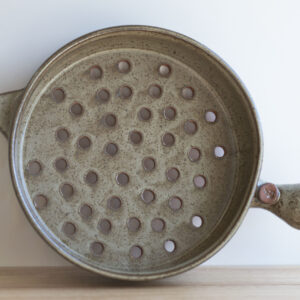
If you don’t have an official couscousier, a stoneware colander and regular saucepan fitted with a rolled aluminum foil seal will do admirably.  Lightly oiling the colander before steaming helps keep couscous from sticking to it.  The main point is, you do NOT use a lid to steam couscous.  The initial wetting of the couscous grains keeps them from falling through the colander.  When you spread the couscous in the colander, be sure to cover all the holes so steam is forced throughout the couscous.

1) Place the couscous in a large round shallow dish. Stir in 1 cup of ice cold water. Let stand for 20 minutes. The couscous will stick together in one large, stiff mass. Break apart the couscous with your fingers using a circular raking motion and by gently rubbing the couscous untill all the grains are seperate.

2) Fill the bottom pot of the couscoussier approximately 1/3-1/2 full of water, place steamer insert on top, bring water to a gentle boil. The water level should be low enough so that there is no risk of it touching the bottom of the steamer.Place the couscous in the steamer insert portion of a couscoussier.  Let steam at a rolling boil uncovered for about 30 minutes.

3)  Using hotpads, turn the couscous into the bowl. Sprinkle with about about 1/4 cup of cold water and 2 tablespoons of salt and add 1/3 stick of butter. The couscous will be very hot from the steam.  Traditionally, North Africans use their hands to incorporate the ingredients, you can use a fork if the heat bothers you. Let stand for about 30 minutes, rake with your hands (or stir with a fork) again to completely separate each grain and return to steamer for a second steaming.

4) Steam for 20 minutes, turn out the couscous into a bowl, add about 1/4 cup of cold water, more salt to taste and 1/3 of the butter, fluff the couscous using the same raking motion, let stand for 30 minutes and return to steamer for final steaming.

5) Turn out the couscous into the bowl, add more salt and butter to taste. The finished product should be light and fluffy, with an al dente texture. It should not be gritty or mushy. Serve on a round platter in a mound.  Juices from cooking the main dish can be spooned over the couscous.

Also Try steamed Corn Polenta as a variation from traditional couscous.  Click here for recipe.

Travel Mug comes home for the Spring open house

The travel mug has returned to the Clay Coyote for our annual spring open house. Here it is with Margaret Ann taking a tour of our gallery.

They are also visiting with our weekend artists. We have Pat Choffrut and her colorful water color paintings. You can also meet Sharon and Don Cherney. Sharon has handcrafted leather bags, and Don has pewter jewelry. We also have Stacey Neuhaus and her handmade soaps. Her Fruit Loops soap smells good enough to eat!  We will be here all weekend. Bring your own travel mug, and we will fill it with something warm.

Paula Wolfert’s Pumpkin Soup with Creamy Roquefort

This one was tried by Ann (in the Gallery) and she kindly brought a small portion for the rest of us!  Like all of Paula’s recipes, this is delicious!

Yield:pumpkin soup
4 to 6 servings
Ingredients:
2 1/2 pounds pumpkin or butternut squash
1 tablespoon sugar
2 ounces sliced prosciutto or lean pancetta, shredded
1/4 cup minced shallot
Salt
Freshly ground pepper
1/4 teaspoon freshly grated nutmeg
1/2 cup crème fraîche or heavy cream
3 tablespoons unsalted butter
2 1/2 ounces Roquefort cheese, crumbled
1 cup diced, crustless dense country bread, toasted in a dry skillet until golden
Method:
Pare the pumpkin, cut it into large chunks, and discard the seeds and fibrous centers. Cut enough of the flesh into 1-inch dice to make 5 cups or 1 1/2 pounds cleaned pumpkin or squash. Place the pumpkin cubes and sugar in the eaternware casserole and warm over low heat. Gradually raise the heat to medium-low, cover with a sheet of parchment paper and the lid, and steam for 10 minutes.

Add the prosciutto and shallot and cook, covered, for 10 minutes longer, stirring occasionally. Season with salt, pepper, and nutmeg.

Add 3 cups hot water to the casserole, bring to a boil, and cook at a simmer until everything is tender, about 20 minutes. Transfer the soup in batches to a blender and puree until smooth.

Add the cream, the butter, and the cheese to the last batch of soup in the blender and puree until velvety.

Reheat the soup and season with additional salt and pepper to taste. Ladle the soup into warm bowls and top each portion with the toasted croutons.

Rosemary Garlic Roast Chicken

(ed note)  This one’s from Abby who runs the Borealis Yarn Shops in St. Paul MN. Fabulous materials for serious knitters.  Now let’s see about some serious eating!

1/8 cup vinegar (any type, I usually use white)
1 sprig fresh Rosemary
4-6 cloves garlic
2.5-4lb whole chicken

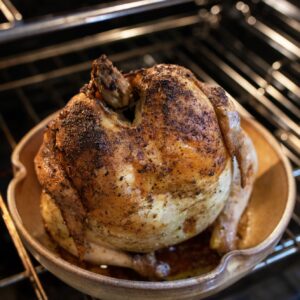
Fill the well of your ‘beer can’ Chicken roaster with 1/8 cup vinegar, 1/8 cup water. Rinse Chicken. Place over well. Cut off the bottom of your garlic cloves. Don’t bother to remove the paper around the cloves. Push the cloves and the Rosemary down the Chicken neck. Place in oven, set oven at 350 degrees, walk away. Chicken will be ready in 2 hours (2.5 lbs ) or 3 hours (4lb).